How to Choose an AI Company in Lebanon: A 2026 Checklist
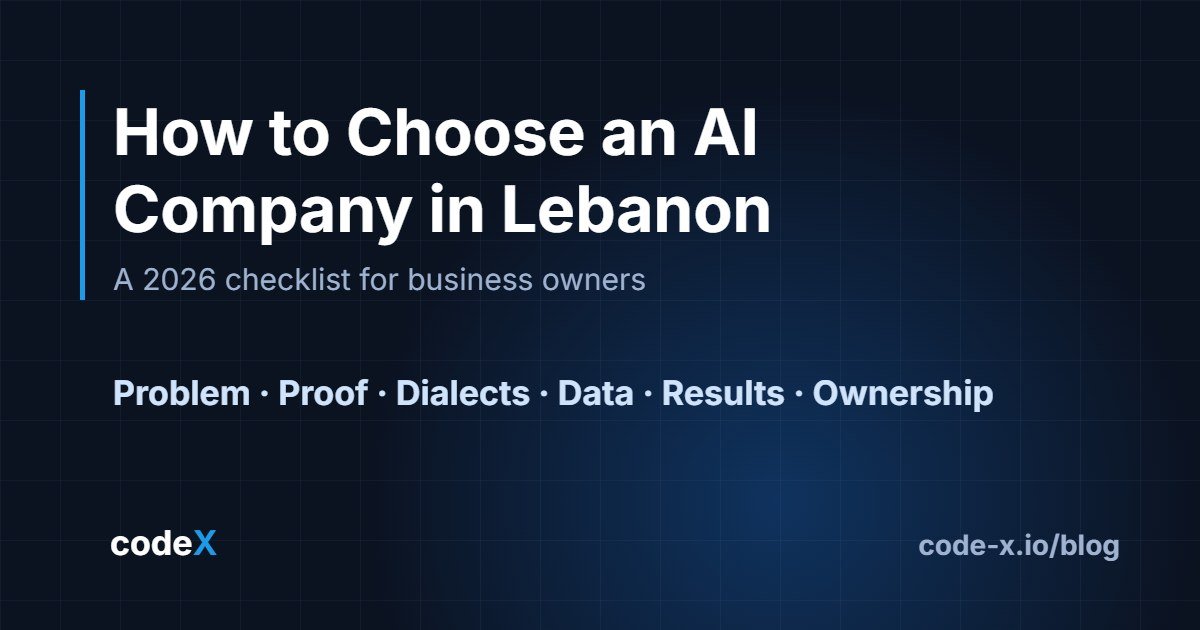
A practical checklist for choosing an AI development company in Lebanon: what to look for, the questions to ask and the red flags to avoid.
More Lebanese companies are ready to put AI to work: chatbots that answer customers on WhatsApp, automation that removes manual data entry, and forecasting that helps managers plan. The hard part is not deciding to use AI. It is choosing the right company to build it, because a weak partner can spend months on a demo that never reaches production.
This guide gives you a practical checklist for choosing an AI development company in Lebanon: what to look for, which questions to ask, and the red flags that should make you walk away.
1. Start with the business problem, not the technology
A good AI partner asks about your process before talking about models. Before you contact anyone, write down:
- The one process you want to improve first, for example customer replies, invoice processing or stock forecasting.
- How it works today, who does it and how long it takes.
- The number that would prove success, such as response time, hours saved per week or error rate.
If a company jumps straight to "we will build you a custom large language model" without asking these questions, that is a warning sign. Most businesses need AI applied to one clear process, not a research project. Our guide on what AI development means for a business explains the main options.
2. Check that they have shipped AI to production
Many agencies can show a polished demo. Far fewer have AI systems running every day for real clients. Ask for:
- Live examples, not only screenshots: a chatbot you can message, an automation you can see working, or a client you can call.
- Named clients in your region and, ideally, your industry.
- What happened after launch: how the system is monitored, improved and supported.
Independent reviews help too. Check profiles on Clutch, GoodFirms and Google, and read what clients say about delivery, not only about the sales process.
3. Make sure they understand Arabic, dialects and your channels
In Lebanon, customers write in Arabic, English, French and Arabizi, often in the same message, and they expect answers on WhatsApp. An AI partner should be able to show how their solution handles:
- Lebanese dialect and Arabizi, not only formal Arabic.
- Mixed-language messages.
- WhatsApp, Instagram and website chat from one place.
Generic global tools often struggle here. We explain why in Arabizi: the next language of the Arab web.
4. Ask how they work with your data and systems
AI only creates value when it connects to the systems you already use: your ERP, CRM, accounting, inventory or call centre. Ask:
- Which systems they have integrated with before (for example ERPNext, Odoo, Salesforce or a core banking system).
- Where your data will be stored and who can access it.
- How they protect personal and customer data, and whether they follow good cybersecurity practice.
A partner that also handles integration and security saves you from coordinating three different vendors.
5. Prefer a delivery model tied to results
Traditional software projects are often sold as a fixed scope, delivered, then handed over. AI works better when engineers stay close to the business while the system learns from real use. Two models are worth asking about:
- A small first project on one process, with a clear success number, before any large commitment.
- Forward-deployed engineering (FDE), where engineers work inside your team on your real data until the system delivers. At codeX, part of the fee in an FDE engagement depends on hitting the KPIs agreed with you.
Either way, insist on a clear timeline from first workshop to a working system in production, measured in weeks rather than many months.
6. Look for ownership, documentation and no lock-in
Before signing, confirm in writing:
- Who owns the code, the trained models and the data.
- That documentation and training for your team are part of the scope.
- What happens if you want to move the system in-house or to another provider later.
Red flags to watch for
- Promises of "fully autonomous AI" with no human review for customer-facing decisions.
- No live examples or references you can contact.
- Vague answers about where your data goes.
- Price quoted before anyone has looked at your process or data.
- Fake reviews or logos of global brands they have never worked with.
Questions to ask in the first meeting
- Which AI systems have you put into production in the last 12 months, and can I speak to one of those clients?
- How will you measure success for our first project?
- How do you handle Lebanese dialect, Arabizi and mixed-language messages?
- Which of our systems will you connect to, and how?
- Where will our data be stored, and who can access it?
- Who owns the code and models at the end?
- What does support look like after launch?
How codeX approaches AI projects
codeX is an AI and software company based in Byblos, Lebanon. Since 2019 we have delivered more than 50 projects across Lebanon and the region, from 3 offices. Our clients include Nakhal Group, TrustMark and Ramtex Group. We build AI automation, chatbots and agentic AI, connect them to ERP and CRM systems, and secure them. Our own products include Lebanese.ai, a dialect-first language engine built for Lebanese Arabic and Arabizi.
Frequently asked questions
How long does an AI project take in Lebanon?
A focused first project, such as a WhatsApp chatbot or one automated process, usually reaches production in a few weeks. Larger programs are rolled out process by process.
Do I need a lot of data to start with AI?
Not always. Many useful projects, like customer-service chatbots and document automation, start with the data and documents you already have. A good partner will audit your data in the first weeks and tell you honestly what is possible.
Should I hire an AI company or build an in-house team?
For most companies, starting with an experienced partner is faster and lower risk. You can then build an in-house team gradually, as long as the partner provides documentation, training and handover.
Related reading: AI automation in Lebanon, AI chatbots for Lebanese businesses and WhatsApp Business API in Lebanon.
Have a process you want to automate? Talk to the codeX team or see how our forward-deployed engineers work.