Arabizi: The Next Language of the Arab Web
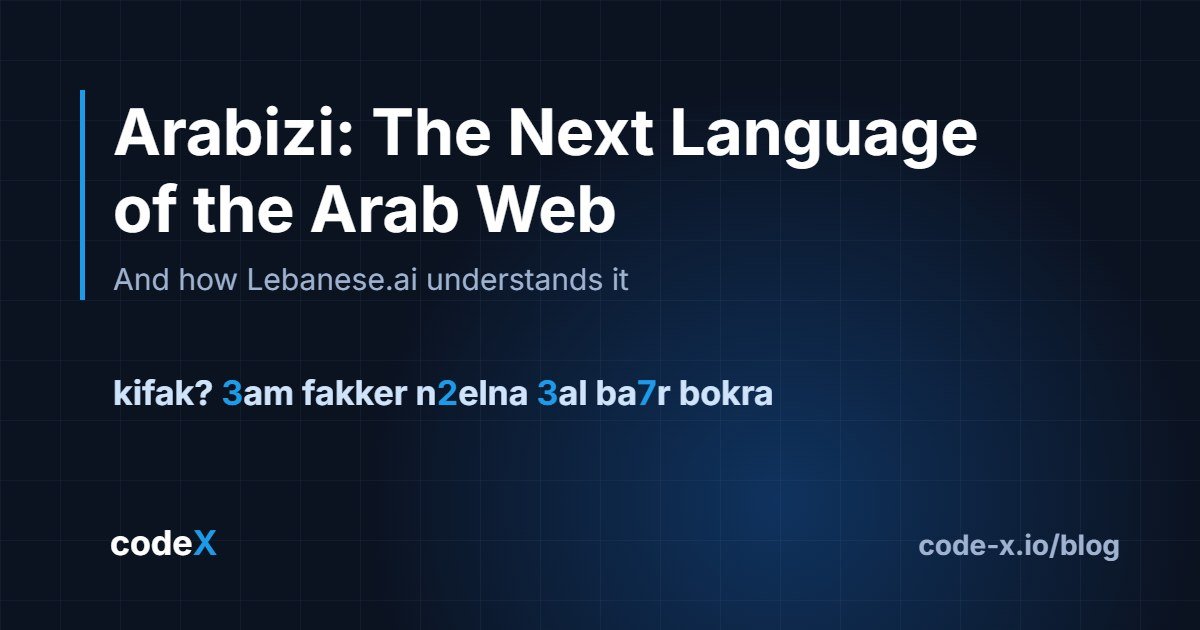
Arabizi is how millions of Arabic speakers write online. Why it is growing, why most AI gets it wrong, and how Lebanese.ai is built to understand it.
Type a message to a friend in Beirut, Amman or Cairo and there is a good chance it will look like this: "kifak? 3am fakker n2elna 3al ba7r bokra." That is Arabizi: Arabic written in Latin letters, with numbers standing in for sounds the Latin alphabet does not have. It started as a workaround on early phones. Today it is how millions of Arabic speakers actually write online, and we believe it will become one of the most important languages for business and AI in the region over the coming years.
This article explains what Arabizi is, why it is growing, why most AI still gets it wrong, and how Lebanese.ai, built by codeX, was designed for exactly this problem.
What is Arabizi?
Arabizi (from "Arabi" and "Englizi") is a way of writing spoken Arabic dialects using the Latin alphabet. Numbers replace letters that have no Latin equivalent:
- 2 for the hamza (ء), as in "2albe" (my heart)
- 3 for ain (ع), as in "3am" (I am, in the middle of)
- 7 for the strong h (ح), as in "7abibi"
- 5 or kh for kha (خ), as in "5alas" (enough)
Arabizi is not one fixed system. Spelling changes from person to person and from country to country, and it is usually mixed with English or French in the same sentence. A Lebanese message can move from Arabic to French to English in five words. That flexibility is what makes Arabizi natural for people, and hard for machines.
Why Arabizi is becoming the everyday language of the Arab web
Arabizi is no longer a youth trend. It is the default for a large share of digital conversation in Lebanon and across the region, for several reasons:
- It is how people speak, not how they were taught to write. Formal Arabic (Modern Standard Arabic) is used for news and official documents, but daily life happens in dialect. Arabizi lets people write the dialect they actually speak.
- Keyboards and habits. Many people grew up typing on Latin keyboards, at school, at work and on their phones. Switching keyboards mid-message is slow, so Arabizi wins.
- Multilingual lives. In Lebanon especially, Arabic, French and English are used together. Arabizi is the one script that holds all three in a single sentence.
- Messaging-first business. Customers now contact brands on WhatsApp, Instagram and Facebook Messenger the same way they talk to friends. If your customers write in Arabizi, your customer service has to read it.
- A generation effect. Researchers have studied Arabizi among young people in Lebanon, Saudi Arabia and beyond for more than a decade. The people who grew up writing it are now the customers, employees and decision makers.
Put together, this means a growing share of what customers say about a business, in reviews, comments, chats and support messages, is written in Arabizi. Companies that cannot understand it are missing a large part of the conversation.
Why most AI still gets Arabizi wrong
Large AI models are trained mostly on English and on formal written Arabic. Arabizi breaks almost every assumption those models rely on:
- No standard spelling. The same word can be written five different ways.
- Little training data. Arabizi is a "low-resource" language for AI, with far less clean text available than English or formal Arabic.
- Code-mixing. Arabic, French and English appear in the same sentence, often in the same phrase.
- Dialect differences. Lebanese Arabizi is not Egyptian or Moroccan Arabizi.
Academic research reflects this. A study from Inria in France described North African Arabizi as a non-standardized, highly variable, resource-poor form of Arabic that is often mixed with French, which makes it hard for language models to process. A 2025 study presented at the MT Summit tested several large language models on decoding and translating Arabizi across dialects, and noted that its informal structure and cultural nuances make it a real challenge for machine translation.
The result for businesses is familiar: chatbots that reply "Sorry, I did not understand", sentiment tools that misread complaints as praise, and transcription that cannot follow how people really talk.
How Lebanese.ai is built for Arabizi
Lebanese.ai is a language model for low-resource dialects, developed by codeX in Lebanon. It starts with the Lebanese dialect and was designed from day one for the way people actually write and speak, including Arabizi and mixed Arabic, English and French.
- Dialect first. Built for dialects with little training data, starting with Lebanese, including mixed scripts like Arabizi.
- Text and audio. The same engine handles written messages and voice, so it can power chat, translation and call transcription.
- One engine, more dialects. The method extends to other dialects and regions, not only Arabic.
- Built by native speakers. The team that builds it speaks the dialect every day, in Lebanon.
- Protected IP. Lebanese.ai is protected by a US patent application for a dialect AI translation system, owned 100% by codeX and now submitted for final approval.
What businesses can do with Arabizi-ready AI
- WhatsApp customer service that answers customers in their own dialect, Arabizi included. See our WhatsApp Business API guide for Lebanon.
- Call-centre transcription that turns dialect calls into searchable text.
- Social listening that understands what customers really say in comments and reviews.
- Document and message translation from dialect to English, French or formal Arabic for teams and partners.
Lebanese.ai is available through an API and through ready-made widgets designed for 20 industries, from banking and telecoms to retail, government and hospitality.
Frequently asked questions
Is Arabizi a real language?
Arabizi is a way of writing spoken Arabic dialects with Latin letters and numbers. It is not an official language, but it is one of the most common ways Arabic speakers write online and in messaging apps.
Why can't ChatGPT or Google Translate handle Arabizi well?
General AI models are trained mostly on English and formal Arabic. Arabizi has no standard spelling, little training data and frequent mixing with English and French, so general models often misread it, especially in specific dialects like Lebanese.
Which dialects does Lebanese.ai support?
Lebanese.ai starts with the Lebanese dialect, including Arabizi and mixed Arabic, English and French. The same engine is designed to extend to other dialects and regions.
How can my business try Lebanese.ai?
You can request a demo on the Lebanese.ai page or contact the codeX team.
Related reading: AI chatbots for Lebanese businesses, what is AI development for business and AI automation in Lebanon.
Ready to understand every customer message, Arabizi included? See Lebanese.ai or talk to codeX.