5 Manual Processes MENA Manufacturers Should Automate First (2026 Guide)

Still running quality checks, production reports, and maintenance schedules manually? This 2026 guide covers the 5 manufacturing processes UAE and Saudi businesses should automate first, with real ROI data and actionable steps.
Every hour your production floor runs on clipboards, spreadsheets, and manual checks is an hour your competitors are pulling ahead. Not because they have better products. Because they made a decision you haven't made yet.
The manufacturers winning in UAE and Saudi Arabia in 2026 are not the ones with the biggest machines. They are the ones who figured out which manual processes were quietly bleeding their margins and did something about it. If you are still deciding where to start, this guide gives you the answer.
Here are the five manual processes MENA manufacturers should automate first, in order of impact, with the data to back each one up.
Why Manual Processes Are the Silent Profit Killer in MENA Manufacturing
Manual processes feel manageable until they don't. A floor supervisor fills in a shift report by hand. A quality checker walks the line looking for defects. A maintenance schedule runs on a fixed calendar regardless of whether the machine actually needs attention.
None of these feel like crises. But they compound.
According to a 2025 McKinsey report on global manufacturing, companies that operate with more than 40 percent manual touchpoints in their production process experience an average of 23 percent higher operational costs than comparable automated facilities. In the Gulf, where labor costs have been rising steadily and Vision 2030 is reshaping the competitive landscape for Saudi manufacturers, that gap is getting harder to ignore.
The UAE's Operation 300bn strategy is targeting AED 300 billion in industrial output by 2031. That ambition requires productivity gains that manual processes simply cannot deliver at scale.
The good news is that you don't need to automate everything at once. You need to start with the right five.
How to Know Which Process to Automate First
Before jumping to solutions, a quick decision framework. The first processes to automate are the ones where:
- Manual execution creates measurable, recurring errors
- The delay between action and information is causing decisions to be made on stale data
- A single person's absence significantly disrupts operations
- The cost of errors is significantly higher than the cost of fixing the process
With that in mind, here are the five processes that meet this test consistently across MENA manufacturing operations.
Process 1: Quality Control and Inspection
The Problem With Manual Quality Checks
Manual quality inspection is still the default in most MENA manufacturing facilities. A trained worker walks the line, visually checks products, and flags defects. It works until it doesn't.
Human inspection has a ceiling. Studies from the National Institute of Standards and Technology show that even trained inspectors miss between 20 and 30 percent of defects during repetitive visual inspection tasks, especially after the first two hours of a shift. Fatigue is real, and so is the cost of the defects that get through.
For manufacturers in UAE and KSA supplying international markets or operating under ISO 9001 quality standards, a defect that reaches the customer is not just a return. It is a relationship problem and often a compliance issue.
The numbers:
- 20 to 30 percent of defects are missed by manual visual inspection (NIST, 2024)
- Manufacturers with automated QC report defect detection rates 4 to 8 times higher than manual equivalents
- Rework and scrap from undetected defects accounts for 5 to 15 percent of total production costs in labor-intensive MENA facilities
What Automation Looks Like Here
AI-powered computer vision systems replace or supplement manual visual inspection. Cameras mounted on the production line capture images at speeds no human can match. A trained machine learning model identifies anomalies, surface defects, dimensional deviations, or assembly errors in real time.
The output is not just a flag. It is a timestamped record with an image, a defect classification, and the exact point on the line where it happened. That data feeds directly into quality management systems and gives production managers something manual inspection never could: a full defect history that improves over time.
For manufacturers in the Gulf automating quality control, the ROI typically materializes within six to twelve months through reduced rework costs, lower scrap rates, and fewer customer complaints.
Process 2: Production Reporting and KPI Tracking
The Problem With Manual Production Reports
Ask a production manager in a typical UAE or Saudi factory how long it takes for shift data to reach leadership. The answer is usually "the next morning, if we're lucky."
Floor supervisors fill in paper or Excel-based shift reports at the end of each shift. Those reports get consolidated, sometimes by a dedicated person, and land on a manager's desk hours after the events they describe. By the time a problem shows up in a report, the opportunity to catch it in real time has already passed.
This is not a small inefficiency. It is a structural blind spot.
The numbers:
- 62 percent of manufacturers in a 2025 Deloitte MENA survey reported that production reporting delays were a top-three operational challenge
- The average gap between a production event and management visibility in manual reporting environments is 18 to 36 hours
- Real-time production visibility reduces unplanned production losses by up to 17 percent (Aberdeen Group, 2024)
What Automation Looks Like Here
Real-time production dashboards pull data directly from machines, PLCs, and sensors on the shop floor. Instead of a floor supervisor filling in a spreadsheet, the system captures output counts, cycle times, machine status, and quality rates automatically.
Management sees live KPIs. OEE (Overall Equipment Effectiveness), yield rate, downtime minutes, and production vs. target are all visible in real time, on any device.
For Saudi manufacturers working toward Vision 2030 production targets, this is not optional infrastructure. It is the visibility layer that makes improvement possible.
The shift from manual production reporting to automated dashboards is one of the highest-return automation investments available to mid-market MENA manufacturers, because it improves decision quality across every other process simultaneously.
Process 3: Inventory and Materials Tracking
The Problem With Manual Inventory Management
Manual inventory management in manufacturing creates two problems that are expensive in completely different ways: stockouts that stop production, and overstocking that ties up cash.
When inventory counts are done by hand on a weekly or monthly basis, the data is always behind reality. Raw materials get consumed faster than expected during a production surge. A component gets damaged, and nobody updates the count. A delivery arrives, and the paperwork takes two days to process. The floor operates on guesswork.
In the Gulf, where supply chains often involve international suppliers with longer lead times, inventory errors are especially costly. A missed reorder trigger does not mean waiting a day. It can mean waiting weeks.
The numbers:
- Manual inventory processes result in inventory accuracy rates of 60 to 80 percent in most facilities, according to a 2024 GS1 report on MENA supply chains
- Automated inventory systems achieve 95 to 99 percent accuracy
- Manufacturers who automate inventory tracking reduce carrying costs by an average of 20 percent and stockout events by 35 percent
What Automation Looks Like Here
Barcode scanning and RFID systems replace manual counts. Every material movement, receiving, consumption, transfer, and return is captured in real time. The data flows directly into the ERP system, which triggers reorder alerts automatically when stock drops below defined thresholds.
For manufacturers integrating this with their production planning systems, the result is a closed loop: production orders drive material requirements, material levels drive reorder triggers, and receipts update inventory automatically. Nobody is manually counting, nobody is guessing, and nothing stops the line because a component ran out without warning.
Process 4: Maintenance Scheduling
The Problem With Manual Maintenance Schedules
Fixed maintenance schedules are built on an assumption that is almost never true: that every machine degrades at the same rate regardless of how it is used.
A machine running at 60 percent capacity on a single shift does not need the same maintenance frequency as the same machine running at full capacity across three shifts. But most maintenance schedules in MENA manufacturing treat them the same, because the schedule was set once and nobody changed it.
The result is a combination of unnecessary maintenance (cost without value) and unexpected breakdowns (the most expensive maintenance of all). Unplanned downtime costs the average manufacturer three to five times more per hour than planned maintenance.
The numbers:
- Unplanned downtime costs manufacturers an average of USD 260,000 per hour in process industries (Siemens, 2024)
- 82 percent of equipment failures are random and not related to equipment age, meaning time-based maintenance misses most of them (ARC Advisory Group, 2024)
- Predictive maintenance reduces unplanned downtime by 30 to 50 percent and maintenance costs by 10 to 40 percent
What Automation Looks Like Here
Predictive maintenance uses IoT sensors mounted on equipment to collect real-time data on vibration, temperature, current draw, and other indicators of machine health. Machine learning models analyze these signals and identify patterns that precede failure, often days or weeks before the failure would occur.
Instead of maintaining on a calendar, maintenance happens when the data says it is needed. This means fewer unnecessary interventions, fewer surprise breakdowns, and a maintenance team that can plan their work instead of reacting to crises.
For Gulf manufacturers running high-value equipment across multiple shifts, the ROI on predictive maintenance is among the highest available. The payback period is typically six to eighteen months, and the ongoing savings compound as the model learns from more data.
Process 5: Production Planning and Shop Floor Scheduling
The Problem With Manual Scheduling
Production schedulers in most MENA manufacturing facilities work from spreadsheets. They know their machines, they know their orders, and they do their best to balance the two. The problem is that the spreadsheet does not update when a machine goes down, when a material delivery is delayed, or when a priority order comes in at 2pm and upends the day's plan.
Manual scheduling always works with yesterday's information in an environment that changed this morning.
The numbers:
- Manual scheduling inefficiencies result in equipment utilization rates averaging 60 to 65 percent in MENA manufacturing, compared to 80 to 85 percent in automated scheduling environments
- Production schedule adherence is 30 to 40 percent higher in facilities using AI-driven scheduling tools
- The average MENA manufacturer loses between 8 and 12 percent of potential production capacity to scheduling inefficiencies (KPMG MENA Operations Report, 2024)
What Automation Looks Like Here
AI-driven production scheduling tools connect to real-time data from the shop floor, including machine availability, order priorities, material stock levels, and workforce capacity. When something changes, the schedule adjusts automatically and flags the impact to the production manager.
The result is a schedule that reflects what is actually possible right now, not what was planned last night. Machines run closer to capacity. Orders ship on time more consistently. And production managers spend their time on decisions, not on rebuilding schedules that are already out of date.
For manufacturers serving international customers with tight delivery windows, or Saudi facilities operating under Vision 2030 export expansion targets, this kind of scheduling discipline is increasingly a competitive requirement.
The ROI Framework: How to Calculate Your Automation Return
Before approaching any automation project, it helps to have a simple way to estimate the return. Here is a framework that works across all five processes above.
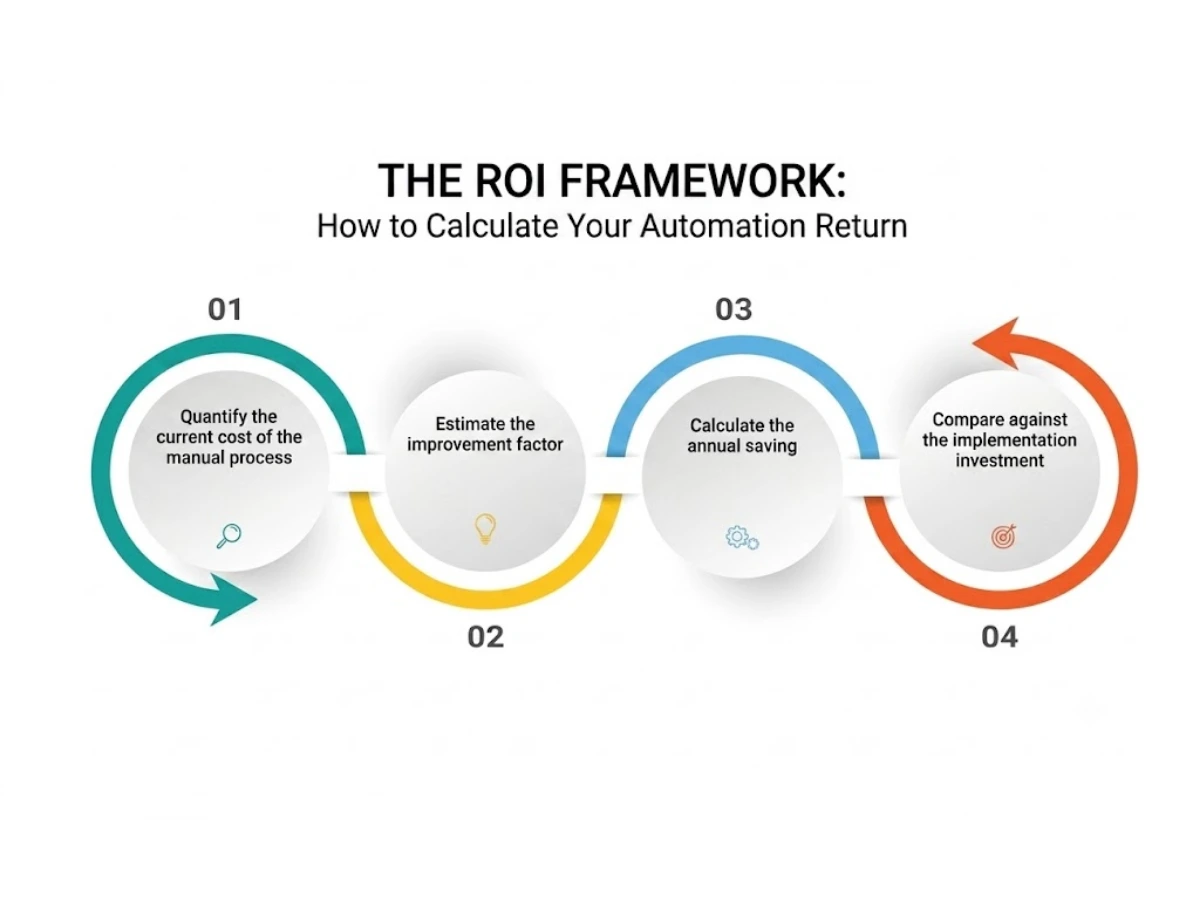
Step 1: Quantify the current cost of the manual process.
This includes direct labor hours, error rates multiplied by the cost of fixing them, downtime caused by the process, and any compliance or quality penalties.
Step 2: Estimate the improvement factor.
Use industry benchmarks as a starting point. Quality automation typically cuts defect rates by 60 to 80 percent. Predictive maintenance cuts unplanned downtime by 30 to 50 percent. Inventory automation cuts stockout events by 35 percent.
Step 3: Calculate the annual saving.
Multiply the current cost by the improvement factor. This is your annual savings estimate.
Step 4: Compare against the implementation investment.
Divide the implementation cost by the annual saving to get your payback period. Anything under 24 months is typically considered a strong automation investment.
Most of the five processes above, when properly scoped for a mid-market MENA manufacturer, return their investment within 6 to 18 months.
What MENA Manufacturers Get Wrong About Automation
Two mistakes come up consistently when MENA manufacturers try to automate and struggle.
Mistake 1: Automating the wrong process first.
The temptation is to start with the most visible problem. But the most visible problem is not always the most impactful one. Starting with a clear ROI calculation, as above, changes the conversation from "where is the biggest headache" to "where is the biggest loss."
Mistake 2: Treating automation as a one-time project.
The manufacturers who get the most from automation treat it as an ongoing capability, not a project with an end date. Each automated process generates data. That data informs the next improvement. The competitive advantage compounds over time.
How the Five Processes Connect
These five processes are not independent. They form a system.
Quality data from Process 1 feeds into production reporting in Process 2. Inventory accuracy from Process 3 enables reliable production scheduling in Process 5. Predictive maintenance data from Process 4 feeds into real-time dashboards in Process 2 and informs scheduling decisions in Process 5.
The manufacturers who automate all five create something more valuable than the sum of five individual improvements: a factory that runs on real data, makes decisions in real time, and improves continuously because every process is generating information that makes every other process smarter.
This is what Industry 4.0 looks like in practice for a mid-market MENA manufacturer. Not a complete digital transformation overnight. Five decisions, in the right order, with compounding returns.
How Codex Helps MENA Manufacturers Automate
Codex is a full-cycle software and AI development company building automation systems for manufacturers across UAE, Saudi Arabia, Lebanon, and the wider MENA region.
If you are reading this and recognizing your factory in one or more of the five processes above, that recognition is worth acting on.
Our AI development and automation services cover everything from machine learning quality control and real-time production dashboards to predictive maintenance systems and full ERP integration. We do not sell hardware. We build the software and AI layer that turns your existing equipment and data into a competitive advantage.
What makes us different is that we build for your specific operation, not a generic template. We start with your current processes, your existing systems, and your specific ROI targets. Then we build something that actually fits how your factory works.
If you are not sure where to start, the right first step is a discovery conversation where we look at your current processes and tell you honestly which automation investment will return the most in your specific situation.
Talk to our team and tell us which of these five processes is costing you the most right now. We will take it from there.
Conclusion
The five manual processes that cost MENA manufacturers the most are quality control inspection, production reporting, inventory tracking, maintenance scheduling, and production planning. Each one is fixable. Each one has a clear ROI. And each one gets more valuable once you automate the others.
The key takeaway is straightforward: start with the process where your current manual execution is causing the most measurable loss. Quantify it using the framework above. Then build from there.
The manufacturers who are pulling ahead in UAE and Saudi Arabia in 2026 are not doing anything magical. They made the same decision you are considering right now, and they made it six months earlier.