Healthcare App Development in UAE: Full 2026 Guide for Clinics, Hospitals and Health Startups
Planning healthcare app development in UAE? This 2026 guide covers what health apps need in Dubai, which features matter most, DHA and DOH compliance requirements, and how to find the right development partner for your clinic or hospital.
A patient books an appointment at 11pm on a Thursday. No receptionist. No phone call. No waiting on hold. They get a confirmation in seconds, a reminder the next morning, and their doctor already has their full history on screen when they walk in.
That's not a future scenario. That's what well-built healthcare apps are doing right now for clinics and hospitals across Dubai, Abu Dhabi, and Sharjah.
And yet plenty of UAE healthcare providers are still managing appointment bookings through WhatsApp groups and keeping patient records in shared spreadsheets. Not because they don't want to improve. But because they're not sure where to start, what's required, or who to trust with something this sensitive.
This guide answers all of that. If you run a clinic, a hospital, a pharmacy, or a health-tech startup in the UAE, you're in the right place.
Why Healthcare App Development in UAE is Growing Fast
The UAE healthcare sector is one of the most actively digitizing industries in the country right now. Several forces are driving this at the same time, and they're not slowing down.
Government policy is leading the push. The UAE's National Health Strategy 2026 explicitly targets digital health transformation as a core goal. The Dubai Health Authority (DHA) and the Department of Health Abu Dhabi (DOH) have both invested heavily in building the infrastructure that supports digital health tools, including unified patient record systems and formal telehealth regulation.
Patient expectations have shifted: UAE residents, many of whom are highly mobile-first and digitally fluent, now expect the same level of digital convenience from their healthcare providers that they get from their banks and retail apps. A clinic that still requires a phone call to book an appointment feels outdated to a growing segment of its own patients.
Telemedicine found a permanent place: After 2020, telehealth went from a niche workaround to a mainstream expectation. Platforms like Seha and Okadoc proved that UAE patients would use remote consultations if the experience was made simple and trustworthy. That opened the door for providers of all sizes to build their own digital consultation capabilities.
The health startup ecosystem is genuinely active: Dubai has become a real hub for health-tech startups, supported by programs at DIFC, Dubai Internet City, and the various free zones offering favorable conditions for technology businesses. Investment in health apps across the UAE is at levels that would have been unthinkable five years ago.
The practical result is that healthcare app development in UAE has shifted from something only large hospital groups considered to something independent clinics, specialist practices, dental chains, and pharmacy groups are actively building right now.
Types of Healthcare Apps Being Built in UAE
Understanding which category your project falls into clarifies what you're actually building, what features are essential, and what compliance requirements apply from day one.
Telemedicine and Virtual Consultation Apps
These apps connect patients with doctors remotely through video, audio, or chat. In the UAE, telemedicine platforms must comply with DHA and DOH licensing requirements, including specific rules about which conditions can be managed remotely and how prescriptions are generated and fulfilled.
Well-known examples in the UAE market include Seha (Abu Dhabi Health Services), Okadoc, and DoctorME. Smaller specialist clinics are now building their own branded equivalents.
Core features this category needs:
-
Video and audio consultation rooms with stable, secure connections
-
In-app messaging between patients and clinical staff
-
Electronic prescription generation that links to licensed pharmacies
-
Patient history visible to the doctor during consultation
-
Appointment scheduling, reminders, and cancellation management
-
Secure payment for consultation fees
Hospital and Clinic Management Apps
These are operational platforms for healthcare providers rather than patient-facing consumer apps. They manage appointments, staff scheduling, inventory, billing, and reporting, often connecting to or built on top of an existing Hospital Information System (HIS).
Core features this category needs:
- Patient registration and profile management
- Appointment calendar and scheduling management
- Electronic Medical Records (EMR) integration
- Billing and insurance claim processing
- Staff scheduling and shift management
- Pharmacy and supply inventory tracking
Patient Engagement and Chronic Disease Management Apps
These apps help patients manage ongoing health conditions between clinic visits. For the UAE, where lifestyle diseases including diabetes, hypertension, and obesity represent significant public health challenges, these apps carry genuine clinical value beyond simple convenience.
A diabetes management app might track blood glucose readings over time, send medication reminders, allow patients to share data directly with their treating physician, and flag concerning patterns before they become emergencies.
Core features this category needs:
- Health metric tracking (glucose, blood pressure, weight, oxygen levels)
- Medication reminders and adherence monitoring
- Wearable device integration (Apple Watch, Fitbit, continuous glucose monitors)
- Secure direct messaging between patient and clinical team
- Progress reports and trend visualization
- Emergency alert functionality with escalation pathways
Mental Health and Wellness Apps
Mental health awareness in the UAE has grown significantly over the past several years, and the demand for accessible, private mental health services has grown alongside it. Apps in this category range from therapist-matching platforms to guided therapeutic programs to mood-tracking tools with clinical oversight.
These apps require particular care in both design and data architecture, since mental health data is among the most sensitive categories that exist and patients need to trust completely that their information is protected.
Pharmacy and Medication Management Apps
Pharmacy apps in the UAE range from prescription upload and delivery services to sophisticated medication management tools that integrate with patient EMRs and flag drug interactions in real time. Several of the larger pharmacy chains in Dubai and Abu Dhabi have built significant digital platforms that handle everything from prescription management to home delivery tracking to refill reminders.
Healthcare App Compliance in UAE: What You Must Know Before You Build
This is where most healthcare app projects either get built correctly or run into serious trouble. The UAE has a clear and enforced regulatory framework for digital health, and building an app that doesn't comply isn't just a legal problem. It's a patient safety problem.
Dubai Health Authority Requirements
For healthcare apps operating in Dubai:
Telehealth licensing. Any app that enables medical consultations between patients and licensed healthcare professionals must be operated by a DHA-licensed healthcare facility. The organization running the platform must hold the appropriate DHA license for the type of care being provided.
Data storage requirements. Patient health data must be stored in compliance with DHA data protection standards. In practice, this means data must reside on servers in the UAE or in jurisdictions formally approved by the DHA, not on general-purpose international cloud infrastructure without specific controls in place.
Healthcare professional verification. Every doctor or clinical professional providing services through a healthcare app must hold a valid DHA license. The platform must have an active process for verifying this status and checking it regularly, since licenses can be suspended or expire.
Department of Health Abu Dhabi Requirements
Abu Dhabi's DOH operates its own regulatory framework that applies within the emirate. For apps operating across both Dubai and Abu Dhabi, compliance with both frameworks is required simultaneously. The frameworks share principles but differ in specifics, which adds meaningful complexity to the development and compliance process.
NABIDH and Malaffi Integration
NABIDH (Network and Analysis Backbone for Integrated Dubai Health) is Dubai's health information exchange platform. Healthcare apps in Dubai that handle patient records are expected to integrate with NABIDH, enabling patient records to be shared securely across licensed healthcare providers within the emirate.
Malaffi is Abu Dhabi's equivalent platform. For healthcare apps operating across both emirates, integration with both NABIDH and Malaffi is required. This is not a small technical task. It requires dedicated engineering work, testing against the platform APIs, and formal onboarding with each platform operator.
Getting this wrong doesn't just create a compliance problem. It breaks the clinical value of the app, since disconnected health records undermine the care coordination that the UAE health system is designed to support.
UAE Personal Data Protection Law
Federal Decree-Law No. 45 of 2021 on Personal Data Protection applies across the UAE and categorizes health data as sensitive personal data requiring a higher level of protection than standard personal information.
This means specific consent processes must be built into the app, restrictions apply to how health data can be processed and shared with third parties, data subject rights (including access and deletion) must be technically supported, and data breach notification obligations apply.
Your development team needs to build these requirements into the technical architecture from the very beginning. Retrofitting data protection compliance onto an app that wasn't designed with it in mind is expensive, disruptive, and often incomplete.
Key Features That UAE Healthcare Apps Need
Beyond the category-specific features, several capabilities apply across almost all healthcare apps built for the UAE market.
Genuine Arabic Language Support
A substantial proportion of UAE healthcare patients are Arabic-speaking. A properly Arabic-language healthcare app isn't just a translated version of the English interface. It requires RTL (right-to-left) layout throughout the entire app, Arabic typography that's readable and clear on mobile screens across different device sizes, and content that's culturally appropriate for an Arab healthcare context.
Apps that treat Arabic as an afterthought, with awkward text direction or content that reads like it came from a machine translator, lose patient trust immediately. In healthcare, trust is everything.
UAE Insurance Integration
A large proportion of healthcare in the UAE is funded through employer-provided insurance. An app that doesn't handle insurance claims, pre-authorization requests, and the documentation UAE insurers require creates serious friction for both patients and providers.
Building this properly means connecting to insurance provider systems, handling pre-authorization workflows, and generating the documentation formats that major UAE insurers accept. This integration is one of the most complex parts of healthcare app development in the UAE and one of the most important to get right.
Multi-Emirates Functionality
Healthcare providers operating across both Dubai and Abu Dhabi need apps that simultaneously comply with DHA and DOH frameworks, maintain integrations with both NABIDH and Malaffi, and handle the administrative differences between the two regulatory environments.
Building for multiple emirates from the start is far more efficient than designing for Dubai and trying to extend to Abu Dhabi afterward. The architecture decisions made early in the project either make multi-emirates expansion straightforward or make it a rebuilding exercise.
Biometric Authentication
Given the sensitivity of health data, strong authentication is not optional. Face ID, Touch ID, and secure PIN authentication should all be supported, with the ability to require re-authentication when the app moves to the background rather than only at initial login.
Session timeout policies need to be appropriate for clinical contexts, where a device left unattended for a few minutes shouldn't remain logged into a patient record.
Offline Functionality
In clinical environments, connectivity isn't always reliable. Core functions like viewing recent patient records, submitting consultation notes, or checking a medication schedule should work without an active internet connection, with data syncing securely when connectivity is restored.
This is particularly important for apps used in hospital ward environments where WiFi coverage can be inconsistent.
Emergency Escalation Pathways
For any app that monitors patient health metrics, a clear and tested emergency escalation pathway is essential. If a patient's blood glucose reading reaches a dangerous level, or a cardiac monitoring reading shows a concerning pattern, the app must alert both the patient and their designated healthcare provider immediately, not on the next scheduled sync.
The escalation logic, who gets notified, through what channel, in what sequence, needs to be designed with clinical input and tested under realistic conditions before the app launches.
Accessibility Compliance
UAE healthcare apps serve a broad population including elderly patients who may have reduced vision or hearing, and patients with disabilities. Building to WCAG accessibility standards isn't just good practice. It's increasingly expected by the DHA and DOH as digital health tools become part of formal healthcare delivery.
The Healthcare App Development Process in UAE
A properly run healthcare app project follows a specific sequence. Skipping stages creates problems that show up later at far greater cost.
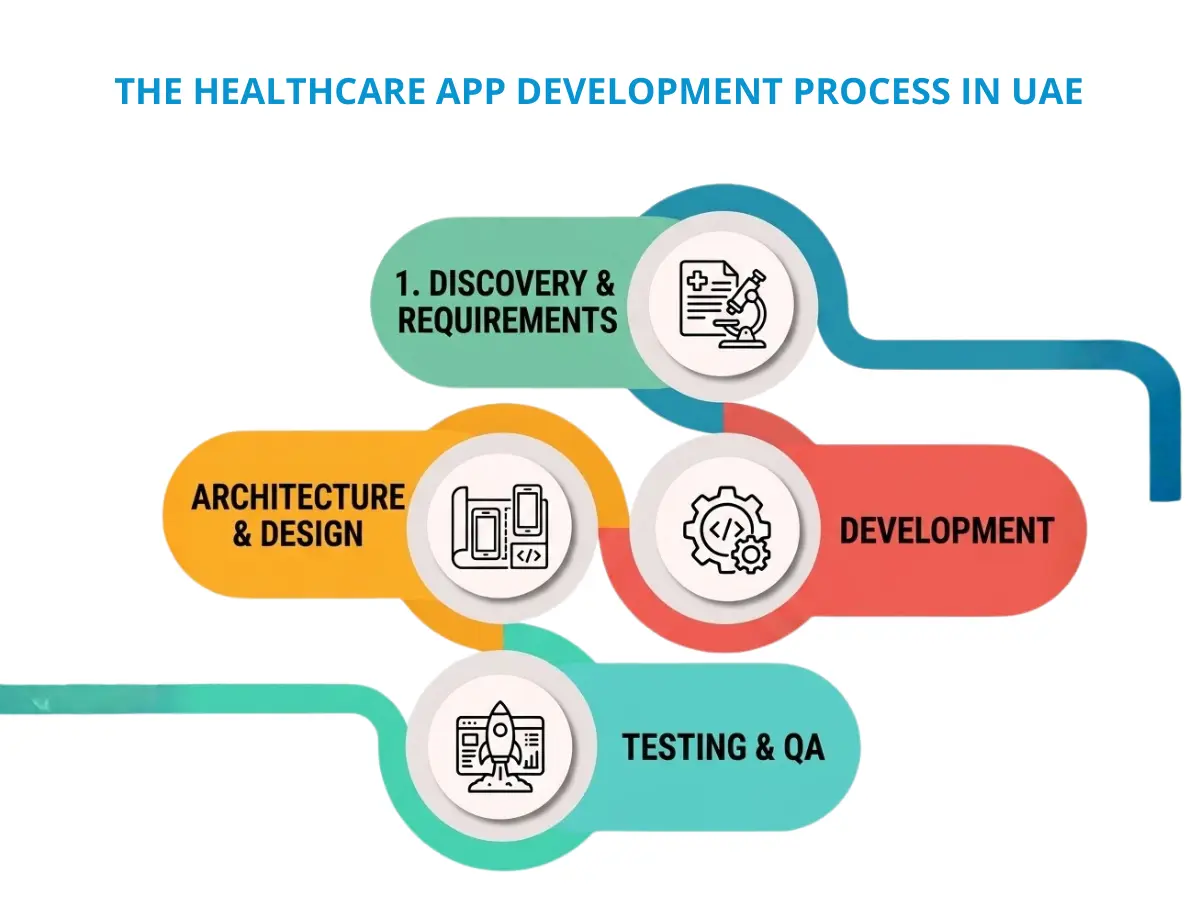
Phase 1: Discovery and Requirements (3 to 5 weeks)
This is where the project is actually defined. Understanding your clinical workflows, patient journeys, regulatory obligations, existing system integrations, and Arabic language requirements all happens here.
The output of this phase should be a detailed technical specification, a compliance map, a realistic project plan, and an agreed architecture approach. Any development company that skips this phase and jumps straight to building is not operating professionally.
Phase 2: Architecture and Compliance Design (2 to 4 weeks)
Designing the system with security and regulatory compliance built into the core. Data models, API design, encryption strategy, access control architecture, audit logging, and compliance documentation are all defined here.
This phase determines whether your app can actually meet DHA and DOH requirements or whether it will run into compliance walls later in the process.
Phase 3: UX and UI Design (3 to 6 weeks)
Creating wireframes and interactive prototypes for both Arabic and English interfaces. Clinical staff, not just designers and developers, should review and test these prototypes before a single line of production code is written.
The workflows that make sense to a developer often fail in actual clinical environments. Finding this out during design is far better than finding it out after launch.
Phase 4: Development (12 to 24 weeks depending on scope)
Building the app in structured stages, starting with core features and adding complexity progressively. Integration work, including NABIDH and Malaffi connections, insurance provider APIs, and EMR platform connections, typically runs in parallel with core feature development and needs dedicated engineering capacity.
Phase 5: Security Testing and Compliance Review (3 to 6 weeks)
Penetration testing, vulnerability assessment, compliance documentation review, and formal security audit. This phase cannot be compressed without accepting real risk. Healthcare apps hold sensitive data and are responsible for patient safety. Security testing needs to be thorough.
Phase 6: User Acceptance Testing (2 to 4 weeks)
Real clinical staff and real patients testing the app under conditions as close to actual use as possible. This phase catches the workflow problems and usability issues that internal testing misses.
Phase 7: Staged Launch and Ongoing Monitoring
Launching first to a limited, controlled user group rather than all patients at once. Monitoring performance, user behavior, error rates, and integration stability closely during this period. Expanding to full launch once the app has proven stable under real conditions.
Mistakes That Sink UAE Healthcare App Projects
Understanding what goes wrong helps you avoid it.
Starting development before compliance is mapped. Building features and then trying to make them compliant after the fact is expensive and sometimes forces a near-complete rebuild. Compliance shapes architecture, and architecture decisions are made early.
Treating Arabic as a translation task. Arabic UX is a design discipline, not a language task. Apps that bolt on translated text without redesigning the layout, typography, and interaction flows for RTL usage fail Arabic-speaking users and reflect badly on the healthcare provider running them.
Underestimating integration complexity. NABIDH, Malaffi, existing EMR systems, insurance provider APIs, and payment gateways all require significant, dedicated engineering effort. Projects that don't account for this properly run over schedule and over scope consistently.
Not involving clinical staff in design. Developers who have never spent time in a clinic, observed a nurse's workflow, or watched a receptionist manage a busy waiting room build apps that work in theory and fail in practice. Clinical input during design is not optional.
Launching with everything at once. A large, feature-heavy launch is harder to manage, harder to debug when problems appear, and harder for users to learn. Starting with core functionality done well and expanding from there produces better outcomes.
No backup and recovery planning. Healthcare is continuous. If your app goes down at 2am, patients can't access their records and clinical staff can't manage their workflow. Disaster recovery and uptime planning are not afterthoughts in healthcare.
Choosing the Right Healthcare App Development Partner in UAE
This decision carries more weight in healthcare than in almost any other sector. A poor e-commerce app loses sales. A poor healthcare app can harm patients.
Healthcare experience is non-negotiable. A company that has built retail apps and social platforms has not demonstrated the capability to build healthcare apps. The compliance knowledge, security architecture requirements, and understanding of clinical workflows are fundamentally different. Ask for specific healthcare projects they've completed and what regulatory frameworks they've navigated.
Security architecture from day one. Ask specifically how they approach data security. You want to hear about encryption at rest and in transit, role-based access controls, audit logging, penetration testing protocols, and data residency strategy. Vague answers are a serious red flag.
Demonstrated UAE regulatory knowledge. Can they walk you through the DHA and DOH requirements relevant to your specific app type without needing to look things up? Have they done NABIDH or Malaffi integrations before? Do they understand the UAE Personal Data Protection Law and how it applies to health data specifically?
A methodology, not just a quote. The development process outlined earlier in this guide is what a professional healthcare app engagement looks like. A company that provides a quote without describing their methodology for compliance, security, clinical workflow validation, and staged launch is telling you something important about how they work.
Post-launch commitment. iOS and Android platform updates, new DHA requirements, NABIDH integration updates, and feature expansions all require ongoing development capacity after launch. Your agreement should define what post-launch support looks like before you sign anything.
How Codex Helps Healthcare Organizations Build Better Apps in UAE
Building a healthcare app in the UAE requires a partner who understands both the technology and the regulatory environment it operates inside. That combination is rarer than most companies presenting themselves as healthcare app developers would suggest.
Codex is a full-cycle software and app development company that builds healthcare and enterprise applications for organizations across the UAE, Lebanon, and the wider MENA region. Our development team has hands-on experience with the UAE regulatory landscape, including DHA compliance requirements, NABIDH integration, DOH frameworks, and the UAE Personal Data Protection Law as it applies specifically to health data.
We build with security embedded in the architecture from day one. Our cybersecurity capabilities mean the same team building your application also addresses the security design at the foundation level. You're not relying on separate vendors who may not align on what secure healthcare data handling actually requires.
Our design team builds genuine bilingual apps, with Arabic UX designed from the ground up rather than retrofitted from an English interface. We know the difference, and so do your Arabic-speaking patients.
We've navigated the DHA and DOH compliance process, worked through NABIDH integration, and built applications that handle the operational realities of UAE healthcare environments: insurance workflows, multi-location clinical operations, and the patient expectations that come with one of the region's most demanding healthcare markets.
Whether you're a specialist clinic in Dubai building your first patient app, a hospital group planning a broader digital health transformation, or a health-tech startup developing a consumer wellness platform for the UAE market, we work with you from initial concept through to a live, compliant, properly supported product.
If you want to understand what your specific project actually involves before committing to anything, start with a discovery conversation. We'll give you an honest, detailed picture of what building your app requires.
Talk to our team and tell us what you're building. We'll take it from there.
Conclusion
Healthcare app development in UAE is no longer something only large hospital groups have the resources to pursue. The regulatory framework exists, the patient demand is clear, and the development capabilities are available to healthcare providers of all sizes.
What separates successful healthcare app projects from failed ones is almost never the technology itself. It's the process. Compliance mapped before architecture is designed. Security built in from the start. Clinical staff involved throughout. Arabic UX given equal weight to English. Staged launch instead of big-bang deployment.
Get those fundamentals right and you build something that genuinely improves care for your patients and operations for your team. Skip them and you spend far more fixing problems than you would have spent doing it properly from the beginning.
The UAE healthcare sector is moving toward full digital integration faster than most providers realize. The organizations building the right digital infrastructure now are the ones that will be best positioned for what the next five years bring.