Leading Android App Developers in Lebanon for Business & Startup Apps
Looking for Android app development in Lebanon? This guide covers everything from choosing the right developer to what your app actually needs to succeed in the Lebanese and Gulf markets. Updated for 2026.
You had the idea six months ago. Maybe longer. You wrote it down, sketched it out, maybe even told a few people about it. And it's still sitting there, waiting.
Meanwhile, businesses in Beirut, Tripoli, and across the Lebanese market are shipping Android apps that book appointments, process orders, and connect with customers at any hour of the day. Not because they had better ideas than you. Because they found the right team and started.
This is the guide that gets you moving. Whether you're a clinic looking to offer online appointments through an Android app in Lebanon, a retail brand ready to take your catalog digital, or a startup building something the market has never seen, everything you need to make a confident decision is right here.
Why Android Specifically? Understanding the Lebanese Mobile Market
Before you build anything, understand where your users actually are.
Android holds a commanding share of the Lebanese smartphone market. Walk through any neighborhood in Beirut, any university campus, any market in the south or north of the country, and the majority of phones you see are Android devices. Samsung, Huawei, Xiaomi, and a range of other Android manufacturers dominate the devices Lebanese people carry every single day.
This matters for one simple reason: your app needs to live where your customers already are.
If your target audience is the Lebanese market broadly, or if you're serving working professionals, students, small business owners, or anyone outside the premium iPhone demographic, Android is where your attention belongs.
The secondary benefit is Google Play. Publishing your app on Google Play gives you access to a distribution infrastructure that handles discovery, reviews, updates, and installation across every Android device worldwide. For Lebanese businesses targeting both local users and the Lebanese diaspora in the Gulf, Europe, and North America, that global reach is a real advantage.
What Lebanese Businesses Are Actually Building on Android
The range of Android apps being developed in Lebanon right now is wider than most people realize. Here's what's happening across different sectors.
Healthcare and Online Appointment Booking
Online appointments through Android app development in Lebanon have become one of the most requested categories in the last two years. Clinics, dental practices, physiotherapy centers, and specialist physicians are building Android apps that let patients book, reschedule, and receive reminders without picking up a phone.
The shift started out of necessity and has become an expectation. Patients who book online are more likely to show up, less likely to cancel without notice, and more likely to return for follow-up appointments. For a clinic managing a busy schedule, an Android appointment app pays for itself faster than almost any other digital investment.
Retail and Ecommerce Apps
Lebanese retail brands with physical stores are building Android apps that extend their reach beyond their storefront hours and their geographic location. Customers browse, save, and purchase from anywhere, and the brand stays present on the most-used screen in their customers' lives.
Delivery and On-Demand Services
The delivery economy in Lebanon has grown significantly. Food delivery, grocery delivery, pharmacy delivery, and document courier services are all building custom Android apps that handle ordering, tracking, and driver coordination in real time.
Internal Business Tools
Not every app faces the public. A significant number of Android development projects in Lebanon are internal tools built for specific business operations. Field staff management, inventory scanning, sales rep reporting, and warehouse coordination are all being digitized through custom Android applications built for specific workflows.
Education and Training Platforms
Lebanese educational institutions and private tutoring businesses have moved course delivery, quiz management, and student communication to Android apps that work on the affordable devices most students already own.
Finding Top Rated Android App Development in Lebanon
This is where most people spend too little time and pay for it later. Choosing the right Android development partner in Lebanon is the single most important decision in your entire project. Here is exactly what to look for.
Check Their Google Play Portfolio First
Any top rated Android app development company in Lebanon should be able to give you the package names of apps they've shipped. Go to Google Play. Search for those apps. Download them. Use them. An app that loads slowly, crashes on basic interactions, or has a two-star rating with user complaints about bugs tells you everything you need to know about the team that built it.
Live apps in the Play Store are the only credible evidence of Android development capability. Mockups, concept designs, and client logos on a website are not.
Ask About Their Kotlin Experience
Modern Android development is done in Kotlin, Google's officially preferred language for Android. A team still building primarily in Java is working with older practices. Ask directly: what percentage of your Android projects use Kotlin? What's your approach to Jetpack Compose for UI development?
The answers tell you immediately whether you're talking to a team that's current or one that's been coasting on techniques from five years ago.
Understand Their Testing Process
Android runs on thousands of different device configurations with different screen sizes, Android versions, manufacturers, and hardware specifications. An app that works perfectly on a Samsung Galaxy S24 might behave completely differently on a mid-range Xiaomi running Android 11.
Ask any Android developer in Beirut or across Lebanon how they handle device fragmentation testing. A serious team has a defined process. They test across multiple physical devices and use emulator configurations to cover the range of devices their target users actually carry.
Confirm Post-Launch Commitment
Android releases major OS updates annually. Each one can affect how existing apps behave. Google Play periodically updates its policies and technical requirements for apps to remain listed. Your app will need updates, bug fixes, and likely new features over time.
Before signing with any Lebanon-based Android development company, get a clear, written understanding of what post-launch support looks like. How quickly do they respond to critical bugs? What's the process for updates when Android releases a new OS version? Is there a maintenance retainer option?
Android App Development Lebanon Open Now: What to Expect When You Reach Out
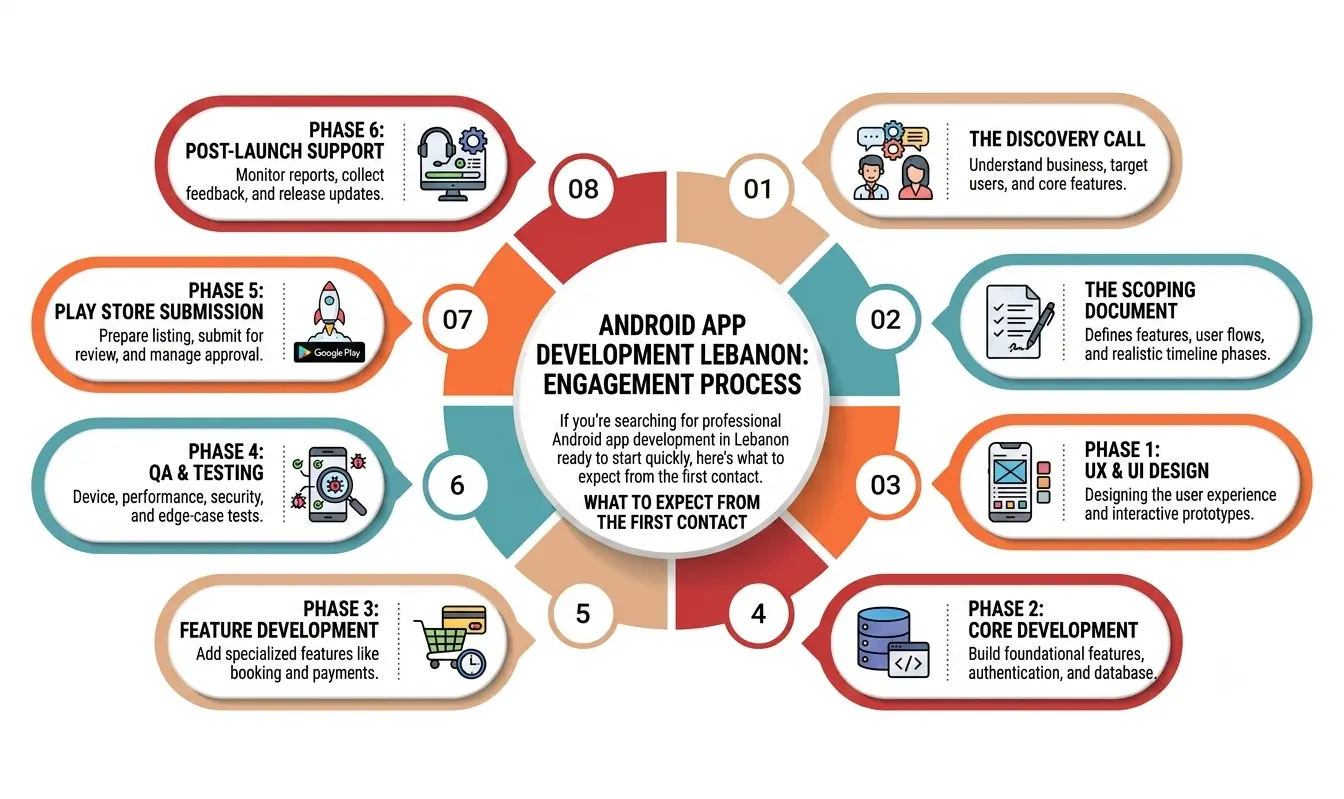
If you're searching for Android app development in Lebanon open now and ready to start quickly, here's what a professional engagement looks like from the first contact.
The Discovery Call
A credible Android development team does not send you a quote after a ten-minute phone call. The first serious conversation covers your business, your target users, your core features, your integration requirements, and your timeline. This conversation should feel like talking to a consultant, not a salesperson.
If the first thing a company does is tell you what it will cost before they understand what they're building, that's a sign to keep looking.
The Scoping Document
After the discovery conversation, a professional team produces a scope document. This outlines the features you've agreed on, the user flows those features involve, the technical integrations required, the platforms and Android versions the app will support, and a realistic timeline broken into phases.
This document is your protection. It defines what you're getting and what happens if the scope changes.
Development Phases
A well-run Android project in Lebanon typically follows this structure:
Phase 1: UX and UI Design
Before coding begins, the user experience is designed and prototyped. You should be able to interact with a clickable prototype that simulates how the app will feel before a single line of production code is written.
Phase 2: Core Development
The foundational features are built first. Authentication, core user flows, database structure, and backend API connections. This phase produces a working build you can test internally.
Phase 3: Feature Development
Additional features, integrations, and platform-specific requirements are built on top of the tested core. This is where appointment booking systems, payment gateways, notification infrastructure, and other specialized features are added.
Phase 4: QA and Testing
Device testing, performance testing, security review, and edge case testing across the full range of Android versions and devices your users will carry.
Phase 5: Play Store Submission and Launch
Preparing your Google Play listing, app store metadata, screenshots, and description. Submitting for review and managing the approval process. A team that has done this many times knows the common rejection triggers and how to avoid them.
Phase 6: Post-Launch Support
Monitoring crash reports, user feedback, and performance data. Releasing updates. Keeping the app current with Google Play requirements.
Android vs iOS: The Lebanon Question
Most articles on this topic try to force a single answer. The real answer depends entirely on your audience.
For most Lebanese businesses targeting the local market broadly, Android comes first. The market share data supports it, and the economic reality of the Lebanese consumer base means Android devices significantly outnumber iPhones in the daily-use category.
For businesses targeting the Lebanese expat community in the UAE, Qatar, Saudi Arabia, and Kuwait, or for healthcare and financial services with a premium client base, the iPhone market share in those segments is higher, and an iOS strategy becomes more important.
For startups that need to validate their idea quickly with real users, starting with Android lets you reach the widest cross-section of the Lebanese market at the lowest barrier to entry.
Cross-platform development using Flutter or React Native is a genuine option when you need to reach both platforms without two separate full development budgets. Done by a competent team, cross-platform apps deliver near-native performance. Done poorly, the performance and UX compromises are obvious to your users within thirty seconds of opening the app.
What Makes an Android App Succeed in the Lebanese Market Specifically
There are things that matter for Android apps in Lebanon that generic development guides never mention.
Offline Functionality is Not Optional
Internet connectivity in Lebanon is inconsistent. Power outages affect routers. Mobile data can be unreliable in certain regions. An Android app that breaks entirely when connectivity drops will frustrate Lebanese users in ways it would not frustrate users in markets with more reliable infrastructure.
Building graceful offline behavior, cached data, and queue-based actions that sync when connection resumes, is not a nice-to-have feature in the Lebanese market. It is a core requirement.
Arabic Language Support Done Properly
Lebanon is bilingual at minimum, and many users switch between Arabic and English within a single conversation. An Android app serving Lebanese users needs full Arabic RTL (right-to-left) support, not just translated text dropped into a left-to-right layout.
Arabic typography on Android requires specific font configuration and text rendering attention that developers unfamiliar with Arabic UI regularly get wrong. Test your Arabic interface with real Arabic-speaking users before you ship.
WhatsApp Integration for Notifications
Lebanese users live in WhatsApp. For many, it is the primary communication channel for everything from family conversations to business coordination. Android apps targeting Lebanese users often benefit significantly from WhatsApp Business API integration for appointment reminders, order confirmations, and customer support, because messages sent through WhatsApp get opened at rates that email and standard push notifications cannot touch.
Performance on Mid-Range Devices
The average Android device in Lebanon is not a flagship. Budget and mid-range Android phones running older OS versions make up a substantial portion of the market. An Android app that runs beautifully on a Pixel 8 but lags on a device from 2020 is an app that excludes a significant chunk of your potential users.
Performance optimization for mid-range devices should be an explicit part of your development requirements, not an assumption.
Red Flags That Tell You to Walk Away
In a market where anyone with a laptop can call themselves an Android developer, knowing what to avoid is as important as knowing what to look for.
No live apps to show: Portfolio images and client testimonials are easy to fabricate. Live apps in Google Play are not.
A quote without a scope: If someone tells you what it will cost before they understand what they're building, they're guessing. And you're the one who pays when the guess is wrong.
No mention of testing: Android device fragmentation is one of the most well-known challenges in mobile development. Any developer who does not bring it up during your initial conversations either does not understand it or is hoping you do not ask.
Unusually fast timelines for complex projects: A basic Android app can be built in six to eight weeks. An appointment booking system with user authentication, a provider dashboard, payment integration, and notification infrastructure takes three to five months minimum. Promises of four-week delivery on complex applications are promises that will be broken.
No post-launch plan: Android development does not end at launch. A company that has nothing to say about post-launch support is a company that plans to be unavailable when you need them most.
How Codex Builds Android Apps in Lebanon
Codex is a full-cycle software and app development company serving businesses in Lebanon, the UAE, and across the MENA region. Our Android and mobile app development team builds production-grade applications that work in the real conditions Lebanese users operate in every day.
We build in Kotlin. We design for Arabic RTL from the start. We test across the device range your users actually carry. We integrate WhatsApp, appointment systems, payment gateways, and backend APIs that hold up under real load. And we stay with you after launch because that's when the real work of building a successful app begins.
If you're looking for top rated Android app development in Lebanon with a team that is available now and ready to start with a proper discovery process, we want to hear about what you're building.
If you need online appointments through an Android app development project in Lebanon, a customer-facing retail app, an internal business tool, or something the market hasn't seen yet, the conversation starts the same way: with us understanding your problem before we talk about any solution.
Talk to our team and tell us what you're building. We'll give you an honest picture of what it takes to build it right.
Conclusion
Android app development in Lebanon is not a complicated decision once you know what you're looking at. The market is there. The talent exists. The infrastructure to publish, distribute, and grow an Android application is fully available.
What separates the apps that succeed from the ones that get abandoned six months after launch is almost never the idea. It is the process, the team, and the willingness to build for how Lebanese users actually behave rather than how a generic template assumes they do.
The key takeaway is straightforward: find a team with live Android apps in Google Play, a defined development process, honest answers to hard questions, and a commitment that does not end at launch. That team exists in Lebanon. Your job is to find them before you commit your budget and your timeline to someone who cannot deliver.